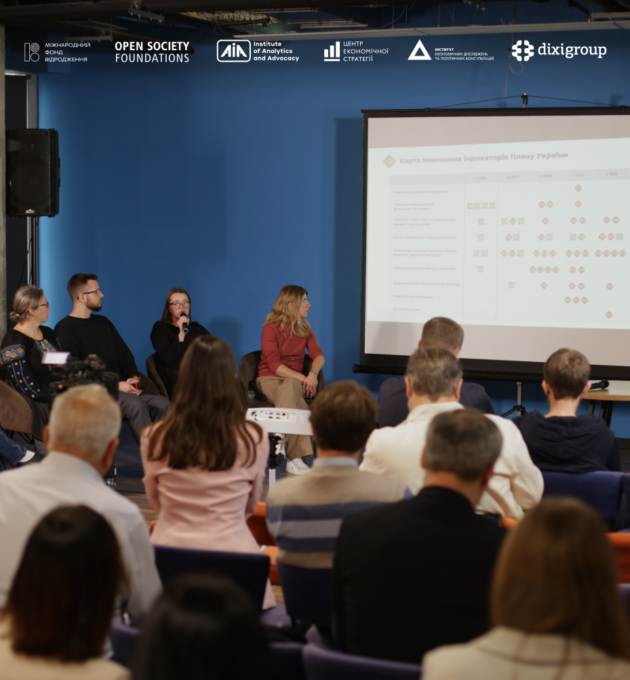

On 31 October, the #RRR4U Consortium presented a new issue of the monitoring of the implementation of the IMF programme and the Ukraine Plan. According to the updated information, Ukraine’s external financing needs for the next year have increased to USD 41.5 billion. The timeliness of these funds depends on Ukraine’s implementation of the promised reforms. During the event, experts from the #RRR4U consortium spoke about Ukraine’s progress in implementing reforms and financing green recovery.
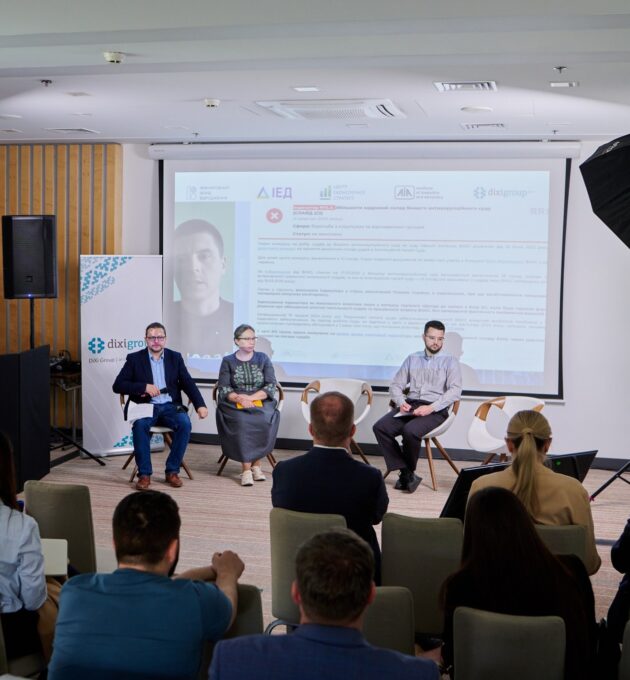
The event was moderated by Andriy Kitura, Development Director of DiXi Group, Head of the Green Transition Office.

In his opening remarks, DiXi Group Research Director Roman Nitsovych stressed that this monitoring traditionally focuses not only on tracking the progress of reforms, but also on their essence.
“It is very important to talk not only about the implementation of the indicators and beacons, but also about the goal they pursue. And the goal here is twofold: the first is, of course, to achieve the implementation of those reforms that are vital for Ukraine. And the second is to maintain financial stability, especially in the current environment,” Roman Nitsovych said.
Many shifts in financial support for Ukraine from its partners took place in October. First of all, a decision was made to provide financing as part of the Group of Seven’s $50 billion package, which will be secured by Russian assets.
“Our consortium has been promoting this step since 2022, so we are very happy that this decision has finally been made, and Russian assets will be used to support Ukraine. However, these funds will be used not only for budgetary support but also for military financing. Therefore, it is too early to say whether next year’s funds will be enough to cover the budgetary needs,‘ Oleksandra Betliy, Senior Research Fellow at the Institute for Economic Strategies and Policy Consulting, commented on the partners’ decision.

Also, in October, the IMF Executive Board approved the 5th review of the IMF programme, which, according to the expert, is explained by two factors: the need for funding for our country, which is an incentive to fulfil obligations in a timely manner, and the flexibility of the IMF. In addition, the macroeconomic forecast has been revised and is now based on the assumption that the hostilities will continue throughout 2025.
The new commitments to the IMF that emerged after the latest programme review include the correction of the negative steps taken earlier in the energy sector. Thus, the full supervisory board of Ukrenergo is to be appointed by the end of this year. Maksym Samoiliuk, economist at the Centre for Economic Strategy, commented in detail on Ukraine’s progress in the IMF agreement.
“The IMF has been very flexible over the past two years compared to previous support programmes for Ukraine.However, this should not be abused ,’ said Samoiliuk.

The third quarter of this year contained certain risks for the implementation of Ukraine’s agreements with the EU, as Ukraine failed to meet one of the indicators of the Ukraine Plan on time. Vitaliy Nabok, Policy and Data Analyst at the Institute for Analysis and Advocacy, spoke about whether Ukraine will receive the next tranche from the European Union.
“This is the first time that we have failed to fulfil one of the indicators of the Ukraine Plan on time. We are talking about the need for amendments to the Criminal Code and the Criminal Procedure Code to come into force. Despite the late implementation of the indicator, the EU said that it would once again meet us halfway and pay the full amount for the third quarter indicators if Law No. 12039 comes into force by the end of October. In fact, it did happen: in the afternoon (31 October), the law was signed by the President of Ukraine,” said Vitaliy Nabok.
According to the experts, the risk of losing the entire tranche, rather than the cost of only one indicator, is due to the lack of a mechanism for allocating partial tranches approved by the European side. It is the existence of such a mechanism that can mitigate the risks of not receiving the full amount of funding due to delays in certain obligations. At the same time, it may somewhat reduce the political will to implement complex indicators and benchmarks.

The special topic discussed the prerequisites and opportunities for attracting green finance to rebuild Ukraine’s economy. DiXi Group Senior Green Transition Expert Dmytro Sych spoke about the activities of the Green Transition Office and the potential for attracting green finance for post-war reconstruction. In particular, the expert presented the results of an analysis of investment projects and reconstruction needs: these are about 400 green projects that require a total of USD 140 billion.
He also explained where Ukraine can get such funds. Ukraine Facility Pillar 2 provides for 20% of funding to be allocated to projects that will have a positive impact on decarbonisation and environmental protection. IFIs declare ambitious goals to increase green finance in the short term. The emissions trading system, in addition to stimulating additional investment in decarbonisation, could become one of the sources of financing for green projects. After all, the revenues will be directed to the Decarbonisation and Energy Efficiency Transformation Fund.

It is also worth considering ‘non-classical’ sources and mechanisms of green financing. The Government of Ukraine is working to attract funding under Article 6 of the Paris Agreement, which provides for cooperation between countries to implement Nationally Determined Contributions. In addition, given the significant amount of external debt, climate swaps #debtfornature #debtforclimate may become a source of green financing, which provide for the mitigation of Ukraine’s debt burden as a result of its investments in decarbonisation and environmental protection measures.
Summing up the event, DiXi Group Development Director and Head of the Green Transition Office Andriy Kitura stressed the importance of monitoring Ukraine’s progress in implementing agreements with partners.
“It is very important that we have such a platform as the Consortium, where we can carry out independent external monitoring of Ukraine’s progress in fulfilling its obligations to international partners. Our joint activities are designed to ensure that we achieve better regulation, better policies, better governance, which will allow us to find more resources to win the war and rebuild Ukraine afterwards. Part of these resources and solutions will be green sustainable finance, one of the important topics we have touched upon today ,’ he summed up.

More details in the material by the link.
The event was supported by the International Renaissance Foundation.
RRR4U (Resilience, Reconstruction and Relief for Ukraine) is a consortium of four Ukrainian civil society organisations: Centre for Economic Strategy, Institute for Economic Research and Policy Consulting, Institute of Analytics and Advocacy, and DiXi Group. The Monitoring is prepared with the support of the International Renaissance Foundation.