
On November 19, the IMF mission completed its work in Ukraine on the sixth review of the EFF programme. IMF representatives and the Ukrainian authorities reached a staff-level agreement. The IMF Board of Directors must approve the agreement. After that, Ukraine will have access to about USD 1.1 billion in funding. THE IMF BOARD OF DIRECTORS IS TO APPROVE THE AGREEMENT. The European Commission and the Council of the EU also agreed to disburse EUR 4.1 billion to Ukraine under the Ukraine Facility, and Ukraine will soon receive the second regular payment for meeting the indicators.
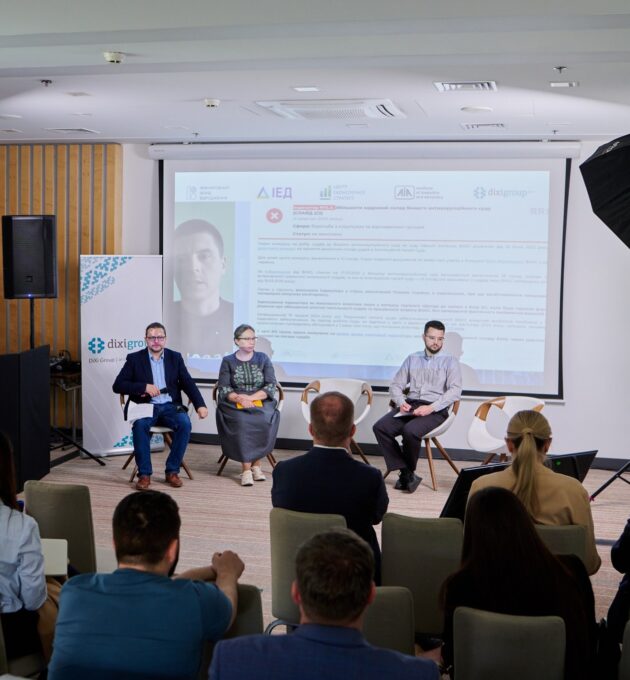
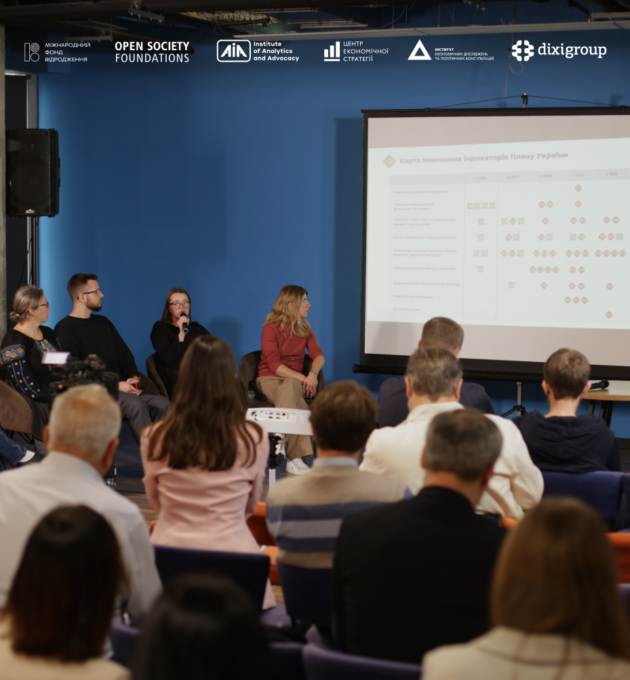
These issues, as well as corporate governance reforms at state-owned enterprises, were discussed by experts during the presentation of the latest issue of the IMF and EU Assistance Monitoring by the RRR4U Consortium, which took place on 10 December and was moderated by Yuriy Romashko, Executive Director of the Institute for Analytics and Advocacy.

‘The budget has been approved: it envisages the need for external financing for the next year at USD 38 billion. Ukraine expects to receive funding from the IMF next year, which, subject to the fulfilment of all structural benchmarks, will amount to USD 2.7 billion. Similarly, under the Ukraine Facility Plan, we can receive €12.5 billion, subject to fulfilment of all obligations. It is also worth highlighting funding under the ERA (Extraordinary Revenue Acceleration Loans for Ukraine) mechanism. To receive funds under this mechanism, on 3 December, the Verkhovna Rada adopted amendments to the Budget Code (Bill No. 1223) and introduced the concept of conditional commitments. This was necessary as it allows Ukraine to avoid repaying the USD 50bn loan to the G7. G7 loan, which will be repaid from the proceeds of frozen Russian assets,’ Yuriy Romashko said in his opening remarks.

By the sixth review of the IMF Programme, Ukraine had met all quantitative indicators and all structural benchmarks. The Fund assessed the benchmarks with a deadline of 30 September 2024. The review is to be approved by the IMF Board of Directors on 20-21 December 2024. This will allow Ukraine to receive USD 1.1 billion. THIS WILL ALLOW UKRAINE TO RECEIVE USD 1.1 BILLION. As of 10 December, Ukraine received 55% of the funding under the current IMF programme ($8.65 billion out of the planned $15.5 billion).
The next, seventh, review of the IMF programme will take place in March. At that time, progress will be assessed against quantitative indicators and structural benchmarks with deadlines in late October and December 2024. Ukraine has met the October benchmarks: the government has developed a state-owned enterprise ownership policy and audited heating companies, and the NBU has assessed key risks to financial stability.
By the end of December, Ukraine has to fulfil eight structural benchmarks. As of now, three of them have been met:
Linkage between medium-term budget planning and capital expenditures has been established
The independence of the National Energy and Utilities Regulatory Commission has been strengthened
The reform of the Accounting Chamber was adopted
‘Some beacons are still in the works, but they are being systematically implemented. This is primarily related to the beacons for which the NBU is responsible. By the end of December, the NBU has to prepare a framework for bank rehabilitation – a special methodology that is currently being agreed with the Deposit Guarantee Fund – and introduce a new risk assessment methodology. According to our information, the NBU is already completing all technical work and we will complete these lighthouses on time. We are also in the process of forming the supervisory board of Ukrenergo,’ said Maksym Samoiliuk, economist at the Centre for Economic Strategy.
However, some of the beacons – in particular, the cancellation of Lozovyi’s amendments and the creation of the Supreme Administrative Court – are problematic. There is little time left to implement them, and no political will to do so honestly. Failure to meet the milestones on time or in part carries the risk that Ukraine will not receive funding of more than $900 million in the spring of 2025.

The European Commission and the Council of the EU have agreed to allocate EUR 4.1 billion to Ukraine. Thus, Ukraine will soon receive €4.1 billion under the Ukraine Facility for meeting 9 indicators in the third quarter. This year, we have already received €12 billion, bringing the total funding in 2024 to €16.1 billion, of which €3 billion is grant support.
‘In December, we expect to receive funds, as well as the planned implementation of 13 indicators for the fourth quarter. Next year, we are waiting for the verification and the next tranche. The European Commission also plans to launch a dashboard on the implementation of the Ukraine’s Plan, which will be launched by January 2025 and updated twice a year,’ said Roman Nitsovych, Research Director at DiXi Group.

This time, the experts also took a closer look at corporate governance reform as an international obligation of Ukraine. Thus, IMF programmes and often EU macro-financial assistance programmes pay attention to this reform. This is because the lack of effective corporate governance poses fiscal risks, as well as fosters corruption and harms economic development. Today’s support programmes are no exception.
The significant impact of state-owned enterprises on the economy is due to their extremely high number:
According to the Ministry of Economy, as of the end of 2022, there were 3,293 state-owned enterprises; of these, 1,058 were operating, 1,552 were inactive, 516 had insufficient information, and 167 were located in the annexed territory of the Autonomous Republic of Crimea.
At the same time, less than 10 SOEs have supervisory boards with independent members, and 89 entities manage state-owned companies, with their functions and responsibilities often overlapping.
The reform is needed to:
Increase the efficiency and productivity of state-owned companies
Reduce fiscal risks
Reduce corruption
Reduce the share of the public sector
‘In line with numerous international commitments from old support programmes as well as new ones, much has already been done in reform. Although some solutions are partial, Ukraine often takes two steps forward and one step back in its implementation. Within the current programmes we monitor, the parliament and government have already adopted important changes: an important law on the triage and corporatisation of state-owned enterprises, a resolution on ownership policy and approaches to its adoption. But this is only the beginning, as many more decisions need to be made and implemented. For example, by the end of the year, the government should conduct a triage and determine the list of enterprises that should be sold, liquidated or retained in state ownership. All strategic enterprises should have a supervisory board, a fair competition for the head of the company and efficient operation. All of this requires effort and political will. We are all facing a rather large and interesting stage of corporate governance reform and I really want the Government to lead this process,’ said Oleksandra Betliy, a leading researcher at the IER.

‘The panacea for quality triage is corporatisation. All state-owned enterprises that are needed by the state should be corporatised, or even if they are not needed and can be privatised, it is better to corporatise them first and then privatise them. This will help us manage strategic state-owned enterprises better.
As for the liquidation of enterprises, we adopted the law in 2023. We expect that the liquidation procedure will start on 1 January 2025, involving about 1,000 enterprises. This is where we expect tangible results,’ said Oleksiy Movchan, MP, Deputy Chairman of the Verkhovna Rada Committee on Economic Development.
To watch the recording of the presentation of the Monitoring of the IMF Programme Conditions and EU Assistance under the Ukraine Facility, please follow the link.
RRR4U (Resilience, Reconstruction and Relief for Ukraine) is a consortium of four Ukrainian civil society organisations: DIXI Group, CES, IER and IAA.
RRR4U releases a monthly Monitoring of Ukraine’s compliance with the terms of key international funding programmes with the IMF and the EU. Quarterly issues additionally contain a more in-depth analysis of a particular aspect of the programmes with international partners. The results of the previous Monitoring are available on the consortium’s website.
The event is supported by the International Renaissance Foundation.